Mindful Knitting | Using Two Needles to Build a Scaffold of Order for Chaotic Thoughts

Mindful Knitting | Using Two Needles to Build a Scaffold of Order for Chaotic Thoughts

Mindful Knitting for Anxiety

This article is for you, if you:

Often start many things, but rarely finish them
Feel anxious at the thought of “how much longer will this take?”
Want to practice mindfulness through real physical action, not just another meditation app
Are a complete beginner to knitting needles—or even a little afraid of them (this is your advantage)

Today, we’re not aiming to finish any project.
We’ll simply use two needles and a ball of yarn to build a visible, removable scaffold of order for your floating thoughts.

Before You Begin

You’ll Need:

  • One pair of knitting needles (recommended: 5–6mm)
  • One ball of medium-weight wool yarn
  • A table where your hands can rest naturally

If you’ve never held knitting needles before — consider that your advantage. You carry no mental burden of having to “get it right.”

Opening: The Sweater That Remained Unfinished for Three Years

Deep in my closet lies a “Museum of Unfinished Projects”:

  • A gray cardigan, 80 stitches cast on (January 2023)
  • A baby sweater that only grew to the armpits (my friend’s child is now in kindergarten)
  • The beginnings of more than a dozen scarves, each a different length

They all began with excitement and met the same killer:
How much longer will this take?”

It wasn’t until a sleepless dawn, staring at that three-year-old sweater, that I suddenly realized:

The true core of knitting has never been “finishing a garment.”
It is, instead, building a visible structure of progress through repetition.

And this is exactly what an anxious mind needs most.

Today, we won’t knit a complete project.
We will only practice: creating order, maintaining order, and allowing release.

Part One: The "Neuroarchitecture" of Knitting Needles

Why are two needles more soothing than one?

1. Two-Needle Synchronization: A Physical Dialogue Between the Left and Right Brain

When the right needle (active) passes through the loop on the left needle (supporting), you are engaging in a highly structured form of bimanual coordination.

Physical Action                                            Neural Metaphor
Right needle pushes                               Left brain: logic, sequence
Left needle stabilizes                             Right brain: spatial awareness, wholeness
Loop transfer                                          Integration of left-right brain information

Research has shown that continuous bimanual coordination activities, such as knitting with needles, can help strengthen the prefrontal cortex—a key region responsible for executive function and emotional regulation.

You are not merely “passing time”; you are training your brain to operate within order.

2. The Concept of a “Row”: Nature's Container for Anxiety

Crochet is a continuous curve, while knitting is a clear row-and-column structure.

The feeling of anxiety                              The structure knitting provides

        Endless                                                           A clear “row” as a unit
    Out of control                                                  Each stitch has its place
No visible progress                          The fabric truly grows with every completed row

The key to mindful transformation is:

Scaling down “I need to finish a sweater” to “I only need to finish this row.”

One row typically takes 5–7 minutes — a “completable unit” that an anxious brain can truly understand.

Part Two: Material Selection — Choosing the Materials for Your Scaffold

The Tactile Psychology of Knitting Needles

   Needle Type                  Tactile  Trait                         Suitable Mental State                                    Mindfulness Prompt
Bamboo / Wood      Warmth, slight resistance        Loneliness, detachment                             The woodgrain carries memories of growth
Metal                              Cool, smooth                     Sticky thoughts, decision fatigue                 Let your thoughts slide with clarity
Plastic                            Lightweight, colorful            Heaviness, low energy                         Use color to brighten your inner space
Circular                    Can be coiled and carried                  Feeling adrift                            Peace can be carried with you

Beginner’s advice:
For the first two weeks, choose a combination that allows you to clearly see every single stitch.

Mindfulness begins with a very simple statement:
I can see myself creating.”


Part Three: The Five-Step Mindful Knitting Method

A Complete Meditation from Casting On to Unraveling

Phase 1: The Casting-On Ritual (Setting Intention)

The most basic cast-on method is perfectly suitable.

Mindful Casting-On Guide:

1、Leave a long tail of yarn (creating breathing room for yourself)

2、With each cast-on stitch, softly name a passing thought

3、Once the row is cast on, gently run your fingers along it and say:
       “These thoughts now have a place to rest.”

Phase 2: The Five-Step Mindful Garter Stitch Cycle

The garter stitch (knitting every row) is the most suitable stitch for mindfulness practice.

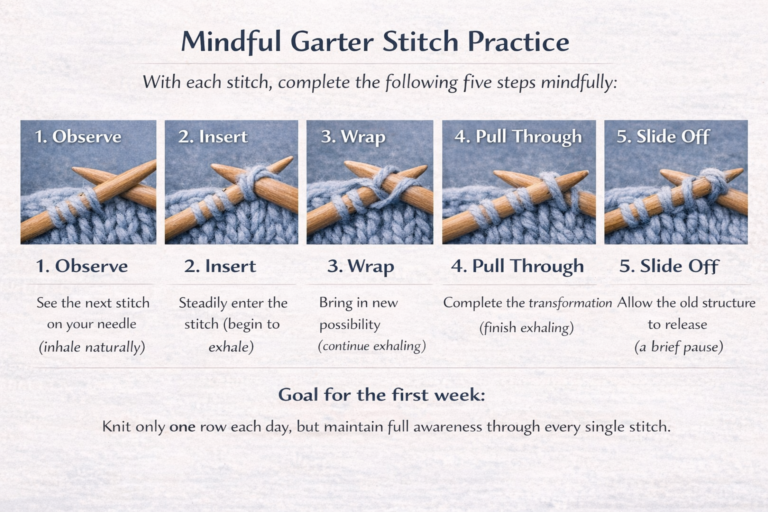
With each stitch, complete the following five steps mindfully:

1️⃣ Observe — See the next stitch on your needle (inhale naturally)
2️⃣ Insert — Steadily enter the stitch (begin to exhale)
3️⃣ Wrap — Bring in new possibility (continue exhaling)
4️⃣ Pull Through — Complete the transformation (finish exhaling)
5️⃣ Slide Off — Allow the old structure to release (a brief pause)

Goal for the first week:
Knit only one row each day, but maintain full awareness through every single stitch.

Part Four: A Simplified Framework for Sustained Practice (From Knitting to Life)

When you reach the middle phase of knitting practice, only three things truly matter: seeing progress, allowing adjustments, and carrying the structure into your life.

1. See Progress: Measure in "Paragraphs," Not "Completion"

Don’t aim to finish any specific project.
Instead, set small paragraphs for yourself (e.g., 8 rows).

Upon completing each paragraph, pause for a moment and acknowledge:

I have completed this small segment.

Only when progress is seen will the mind be willing to continue.

2. Allow Adjustments: Unraveling is also part of practice.

Occasionally unravel 2–3 rows
Not to correct mistakes, but to remind yourself:
I can start again.

In mindful knitting, reversibility matters more than perfection.

is seen will the mind be willing to continue.

3. Carry the structure into life: One-row thinking

What knitting ultimately trains is not a garment, but a way of thinking:

Break complex tasks down to the size of “one row”

Focus only on completing that one row

After finishing, allow yourself to pause and acknowledge the progress

Structure precedes speed.
Stability surpasses force.

Today’s Micro Start

Cast on 10 stitches
Knit one row
Unravel it all

Then say to yourself:
I have completed a full cycle of creating and letting go.”

This is the most essential practice of mindful knitting.

Share & Expand

If you’d like, please leave in the comments:

One item from your “Museum of Unfinished Projects” (just a sentence will do)

Or complete this sentence:

“I need to build a scaffold for ______.”

Leave a comment

Please note, comments must be approved before they are published

What are you looking for?

Your cart